Research-driven AI strategy sprint for GWI
Client
GWI
My contribution
Delivered synthesis workflows, agentic skill library, and opportunity scoring engine with working prototype.

Context

The GWI chatbot didn’t fit enterprise workflows for enterprise customers like Amazon Ads, Disney, Uber Ads, WPP. We uncovered six strategic themes that would align GWI to the AI needs of it’s top clients.
Problem to solve
We weren’t out to “build AI”. We were connecting our customers workflows and strategy to data and insights, while leveraging AI for speed scale and efficiency. This meant mixing AI with traditional tech. The question wasn't just "what do users want?" It was "what does safe, scalable AI access to complex market research data actually look like? And how do clients trust outputs touched by AI"
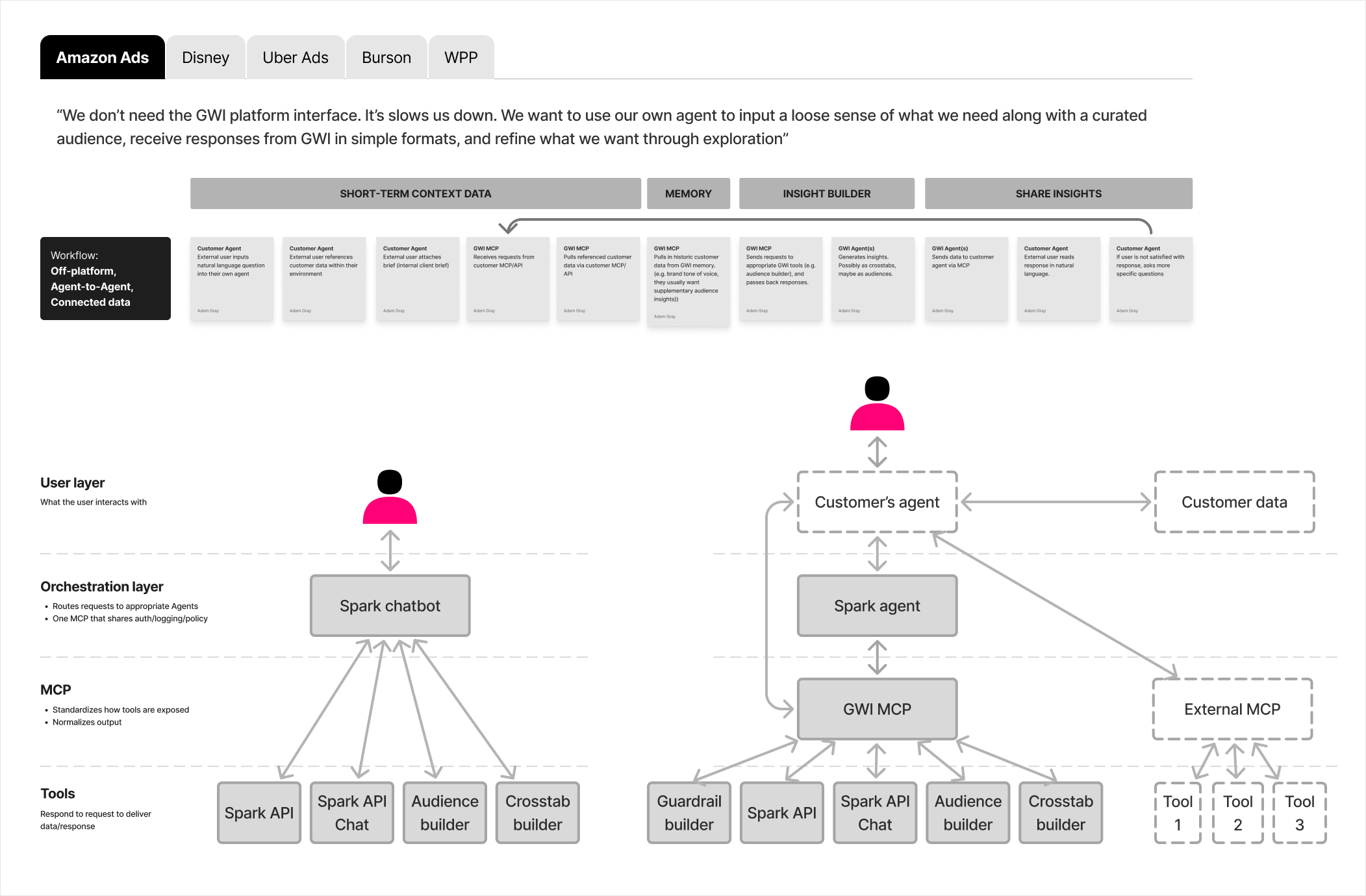
Diagram comparing off-platform agent workflow: user layer, orchestration, MCP, and tools with on-platform GWI agent (Spark) workflow.

Research approach

We interviewed our top clients, all power users or decision-makers using GWI data. I used AI to synthesise the research fast. The whole thing moved faster than a traditional project would have reached consensus on the research plan, because I built the synthesis infrastructure myself.

‍Interviews → custom AI Synthesis → Strategy → Vision design. Four phases, one sprint. Each phase fed directly into the next. No lost meaning between interview and insight.
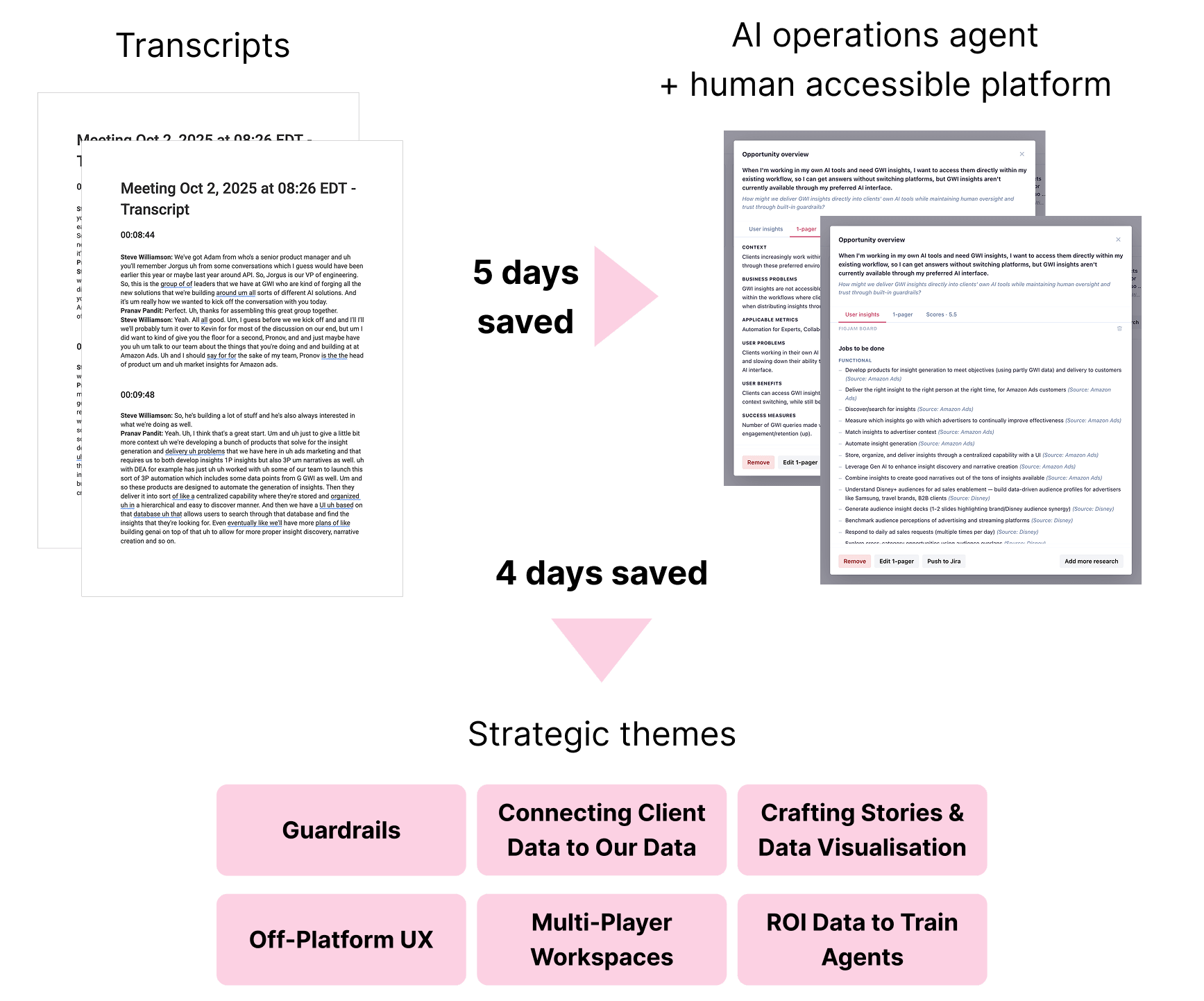
Diagram showing transformation of meeting transcripts into Jobs To Be Done research and strategic research themes, labeled with time saved from AI approach.

The tension that emerged

Two things were true simultaneously: clients wanted their teams faster, more agentic access to GWI data, and they were acutely aware of what could go wrong if less-experienced colleagues got that same access unsupervised. "Sales and media teams can misinterpret or cherry-pick data to support a pre-decided narrative if given direct platform access, with no guardrail." - Participant, Uber Ads

This wasn't a feature request. It was a design constraint that needed to become a design principle.
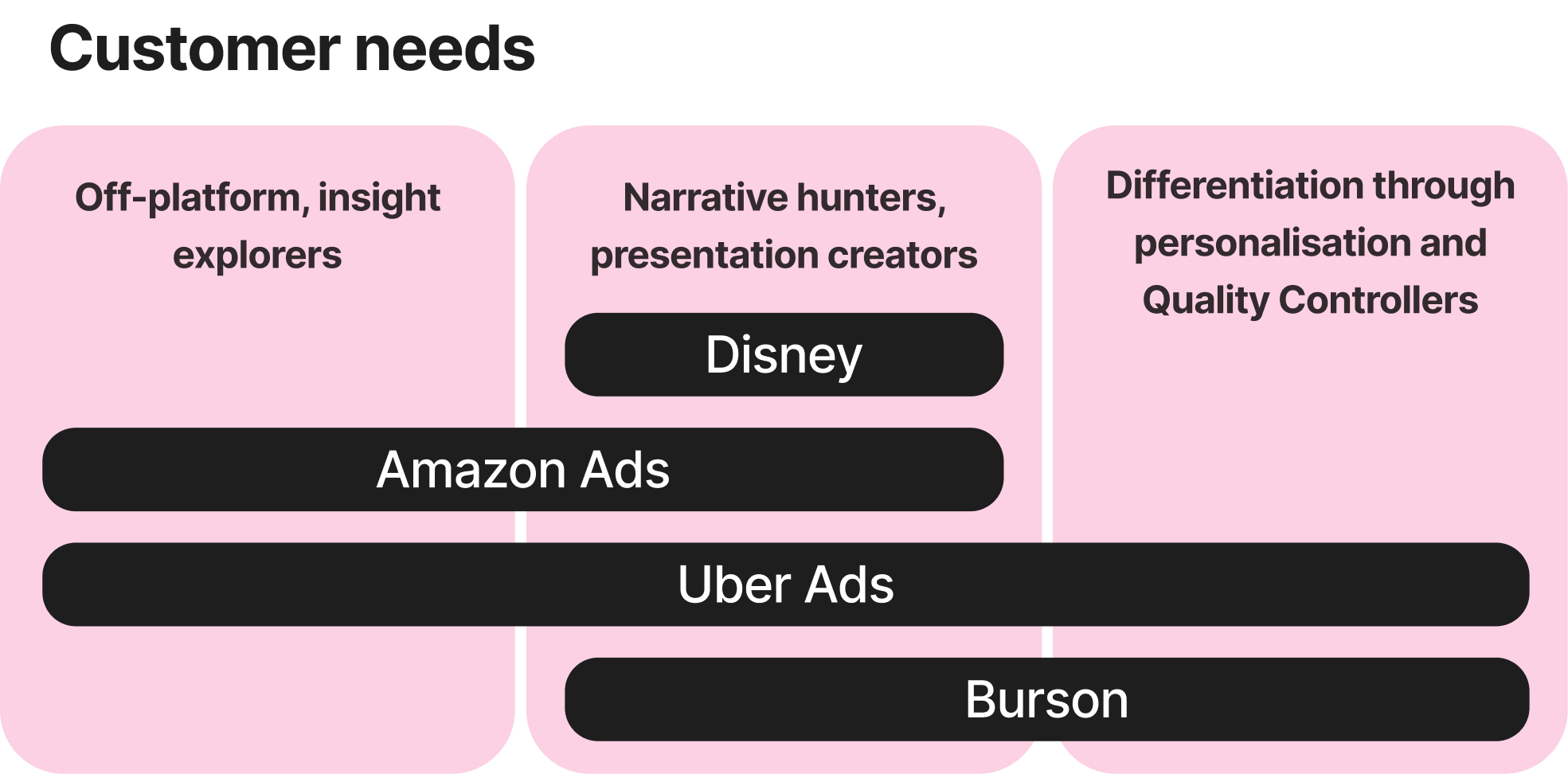
Infographic showing three categories of customer needs and how GWI customers span each category. Customers include Amazon Ads and Uber Ads and Disney

Research synthesis

The old way: Collect transcripts, read them, move quotes into a Figjam board, spot patterns, write up findings. Days of work, and meaning gets lost at every handoff.

What I did instead: I built a research synthesis workflow, one of several agentic skills I developed as part of a broader AI design operations practice. The workflow ingests raw transcripts, FigJam boards, and documents, and outputs structured pain points, gains, and jobs-to-be-done in minutes, using the Strategyzer Value Proposition Design framework as its output structure.
Diagram showing simple AI Operating system architecture.

Strategic recommendation

Operating Principles
  • Focus on goals, and success measures, not designing system steps. AI is good and finding the way through.
  • Build guardrails around the things that that need control and oversight.
  • 40-80% of project time is assembling humans to understand, align and decide how to execute. Reorganise teams to have the means to deliver, not execute what they are told to deliver.
  • Our products and operating model is optimised for determinism, which alone, is no longer competitive. We need to lean into the non-determinism of AI.
Product strategic pillars
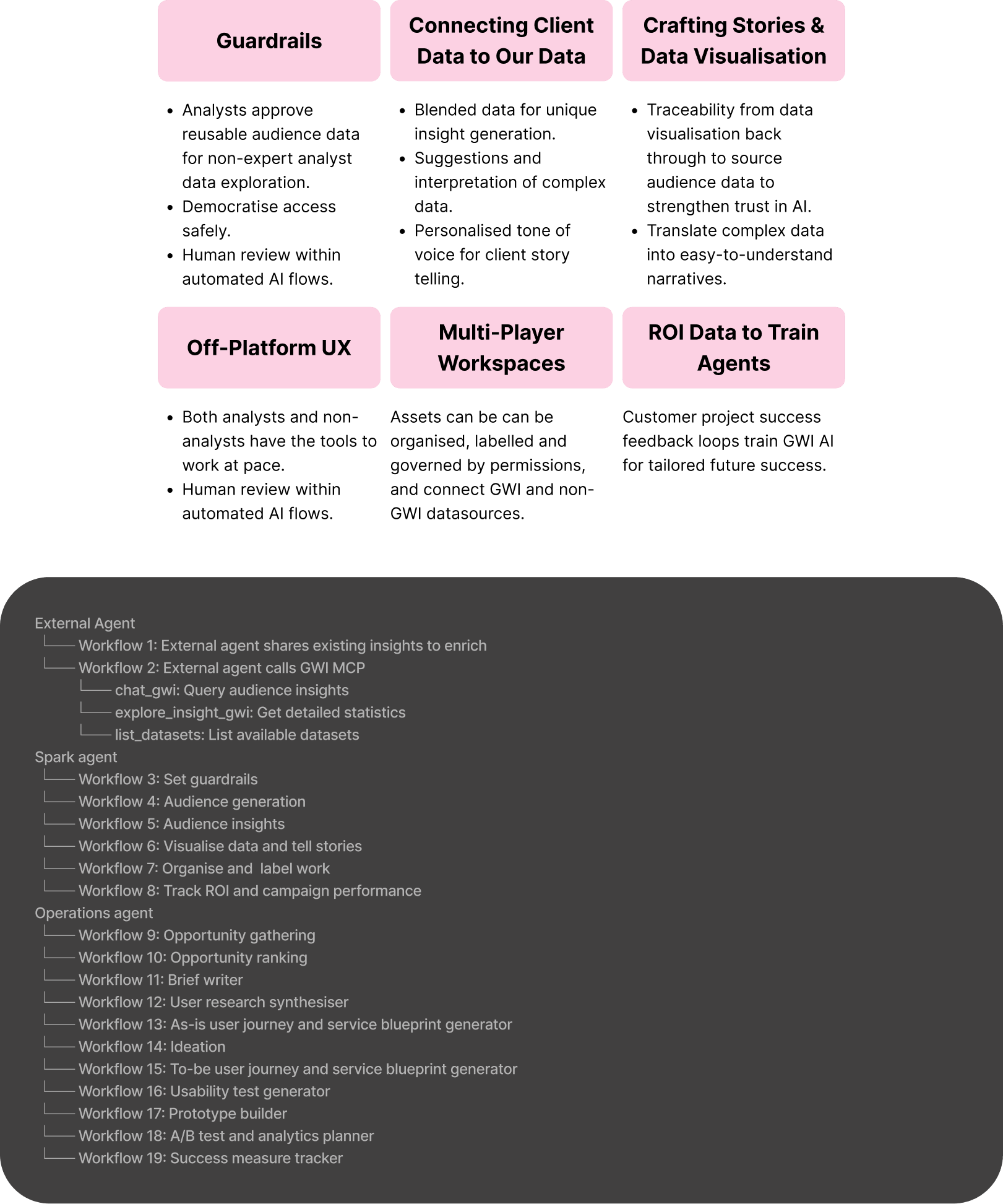
Every client need could be met through 6 strategic pillars:
Infographic showing AI research strategic themes: Guardrails, Connecting client data to our data, Crafting stories and data visualisation, off-platform UX, multi-player workspaces, ROI data to train agents. Below it lists the workflows to support them.
Infographic showing AI research strategic themes:. Below it lists the workflows to support them.
This resolves the core tension without locking down access or requiring data literacy from everyone who touches the output. It's how you give Amazon Ads and Disney's sales teams real AI-powered insight access without the risk that concerned their research leads.

GWI platform design

Agent Spark was still a valuable tool for non-experts, if served as a part of a wider offering. We used Spark as an agile test bed for the strategic pillars of visualisation,  guardrails and connected GWI tools that were previously seperate apps.

In addition, as part of my design operations practice at GWI, I designed and built:
  • A research synthesis workflow — ingests call transcripts, FigJam boards, and documents; outputs structured pain points, gains, and jobs-to-be-done in minutes using VPD as the output structure. This sprint's synthesis ran through it.
  • An agentic skill library — codified repeatable design tasks (brief generation, opportunity scoring, synthesis, documentation) into AI-executable workflows. Any team member can run them.
  • An opportunity scoring engine — ingests product opportunities from any source, rewrites them into consistent problem-statement format, scores against business metrics (ARR, retention, churn), and outputs a ranked list. Before this existed, the team had no way to compare opportunities like-for-like.
  • A working prototype — built in Claude Code and Next.js, with login, user management, opportunity ingestion, scoring, brief creation, ideation support, and Jira push. Built to demonstrate the concept at proof-of-concept fidelity and secure investment.
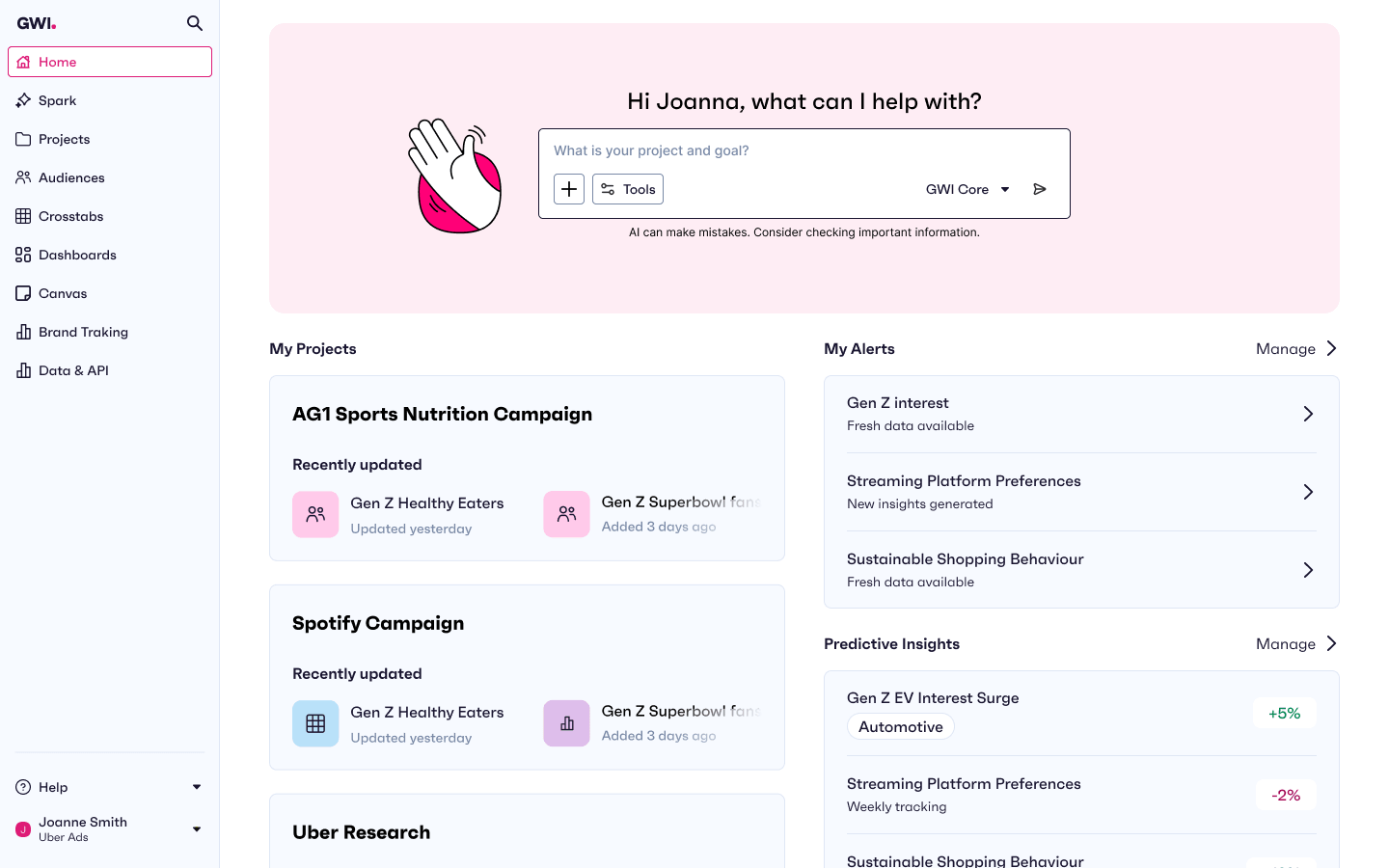
GWI AI driven home page dashboard, showing recent project recent updates, data alerts, and predictive insights
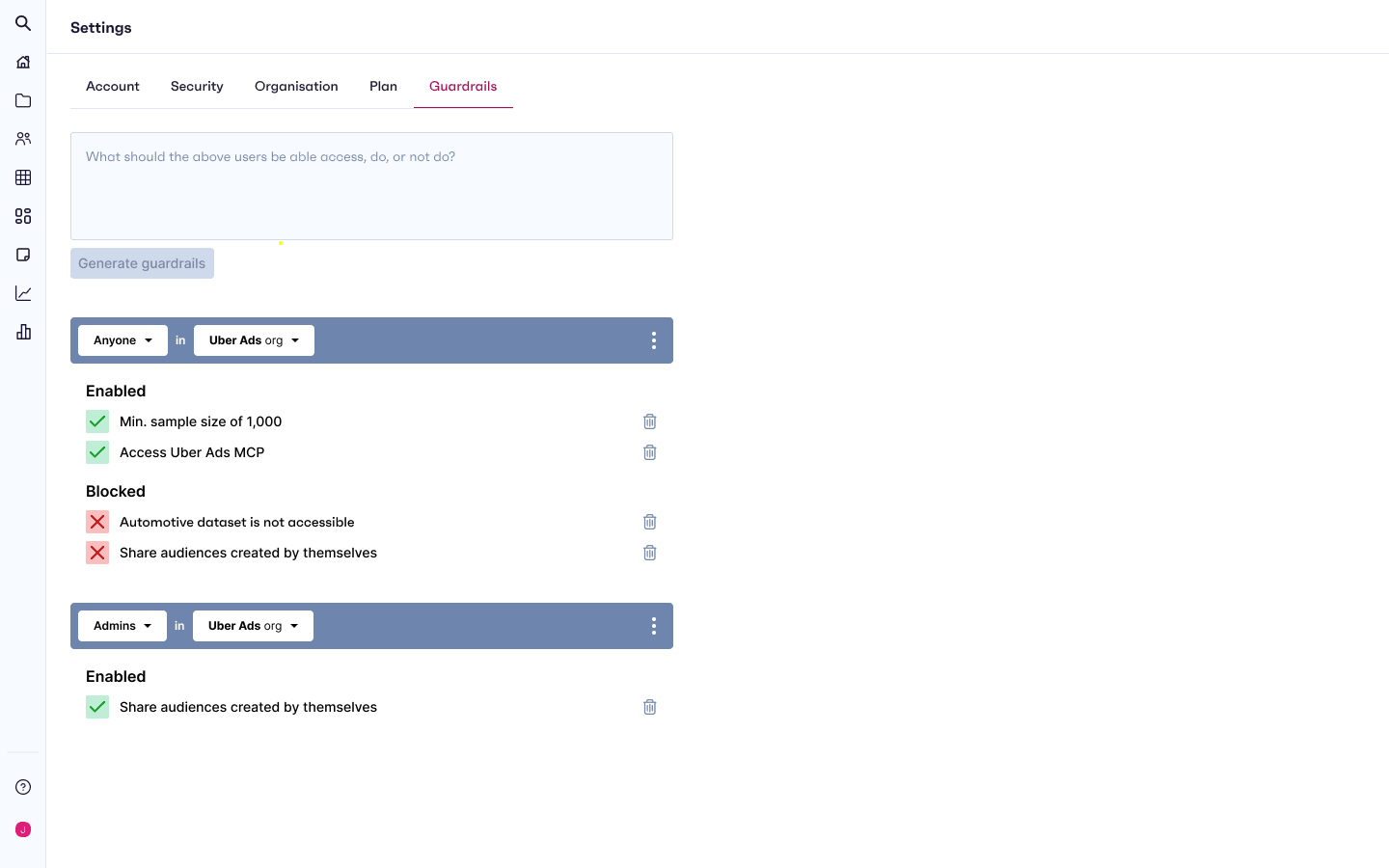
GWI guardrails screen design, showing granular data and feature access and restrictions, to enable trusted data usage by all users
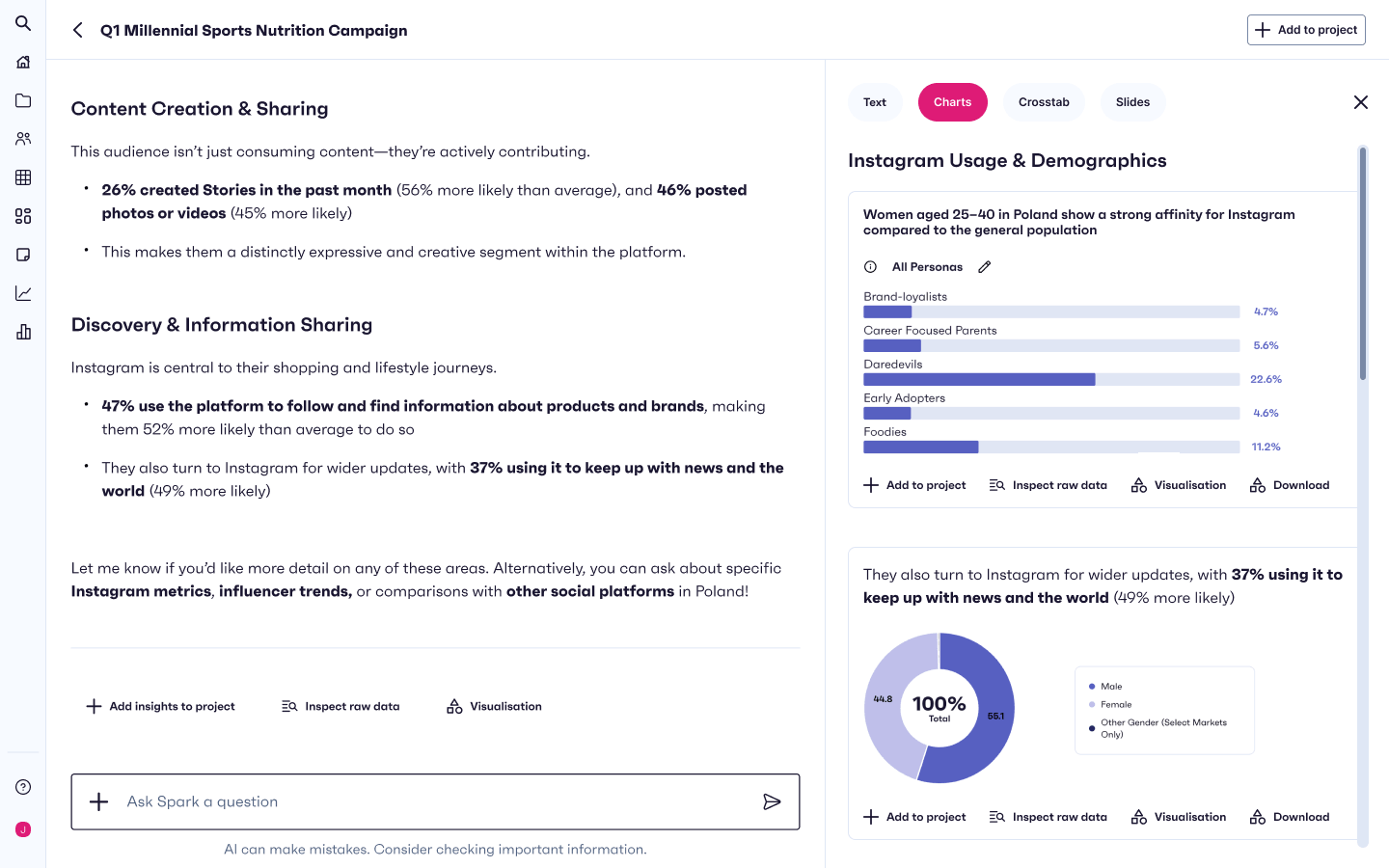
GWI Charts app split-screen design, showing agent interpretation and editing interface, and data visualisation as charts
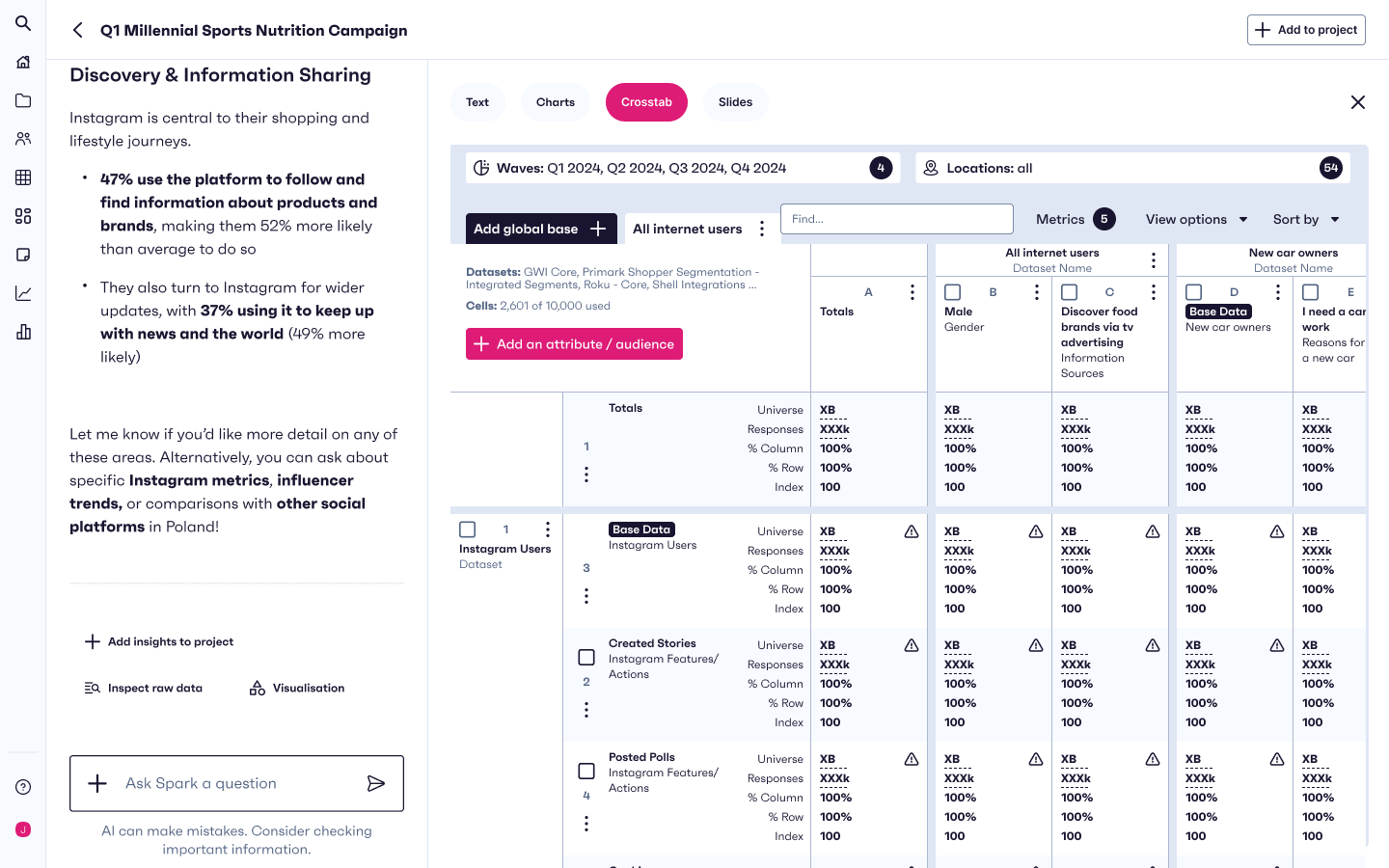
GWI Crosstabs app split-screen design, showing agent interpretation and editing interface, and data visualisation as a crosstab
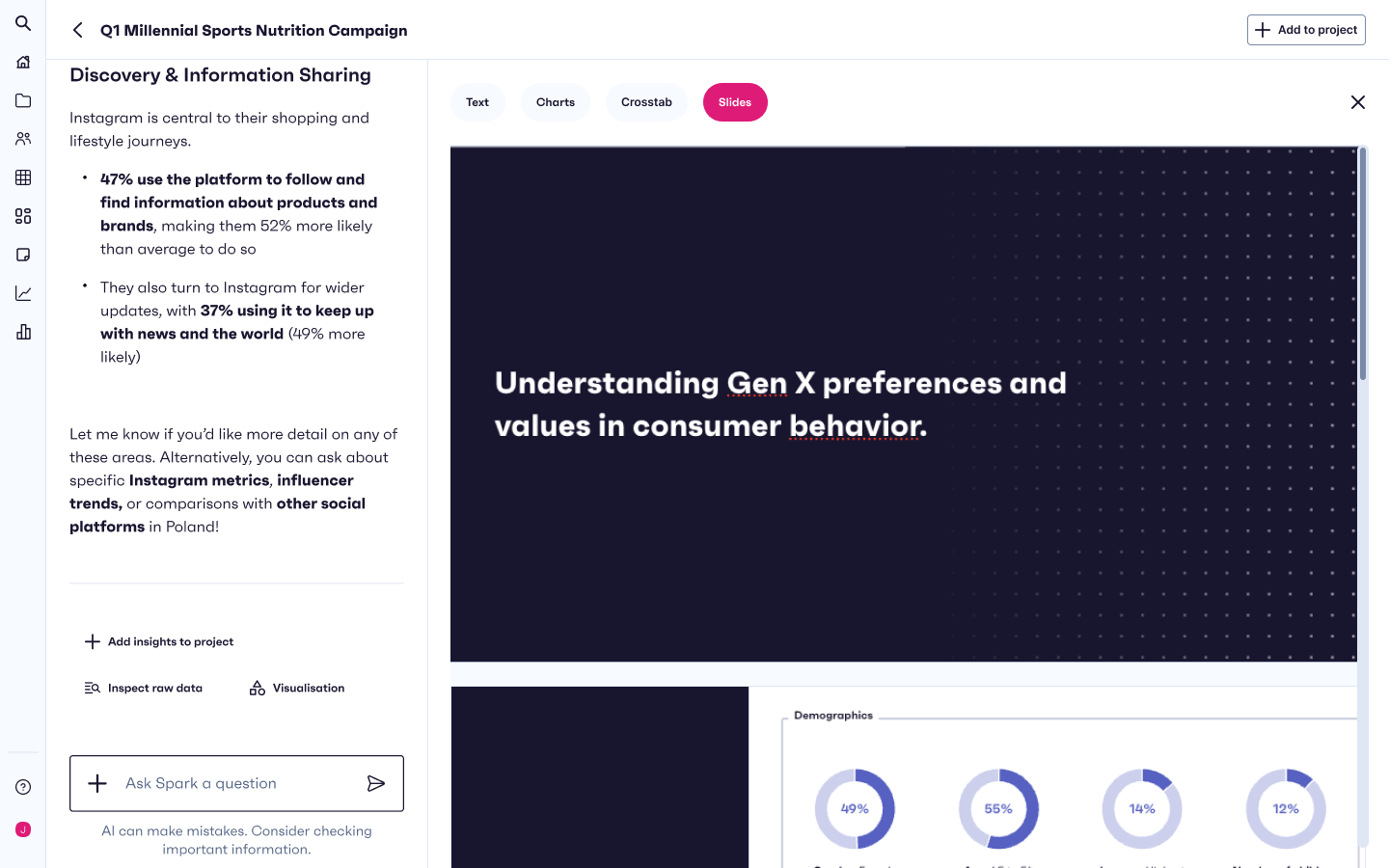
GWI Canvas app split-screen design, showing agent interpretation and editing interface, and data visualisation as a slide deck

Learnings

The biggest risk with AI-powered data tools isn't that the AI gets things wrong, it's that the wrong person acts on an output they don't fully understand. The design challenge is almost never "make the AI smarter." It's "design the human context around the AI so that the right people can trust it and the wrong people can't misuse it."

That is the core product problem to solve.
Click highlight to open ico